
With the rise in customer inquiries and a nearly 40% attrition rate among agents, businesses face a mounting challenge in delivering consistent, high-quality support. This growing burden impacts customer experience and, ultimately, revenue. In response, companies initially relied on traditional chatbots for assistance. However, these bots are inherently limited and designed for specific tasks, lacking the flexibility required to engage in meaningful, context-rich conversations.
Virtual agents represent the next evolution in conversational AI, designed to enhance self-service while maintaining the adaptability and intelligence that traditional chatbots lack. Let’s explore how virtual agents revolutionize customer interactions and bring unprecedented benefits to businesses looking to streamline support services.
Why Traditional Chatbots Fall Short
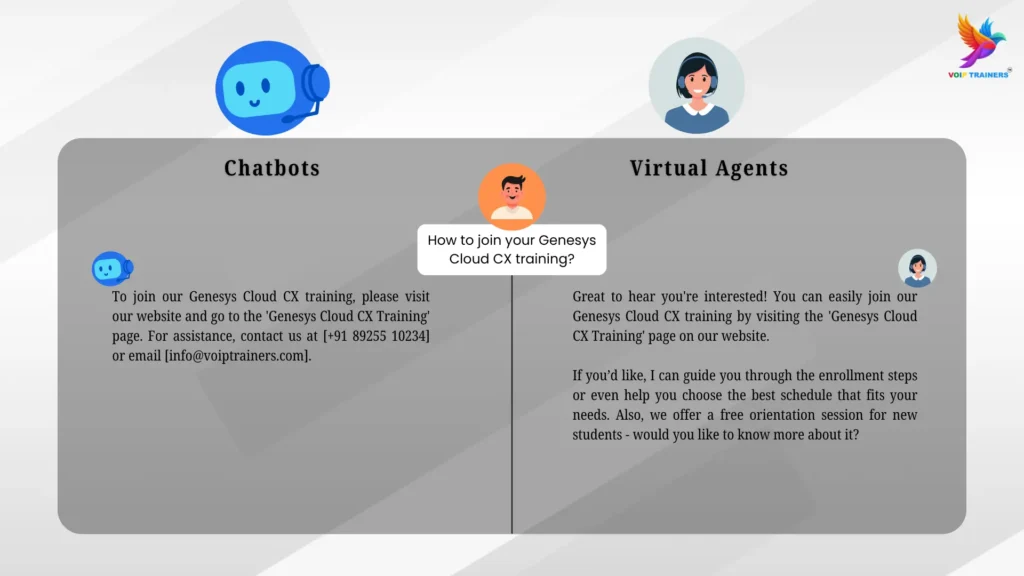
Traditional chatbots follow pre-set scripts and are often confined to specific tasks, such as answering FAQs or gathering basic information. However, these limitations prevent them from handling nuanced questions or adapting to dynamic conversations, which leads to frustrating experiences when users are forced to repeat themselves. Moreover, when bots escalate inquiries to human agents, they often lack the context necessary for seamless handovers, negatively impacting customer satisfaction.
In contrast, virtual agents utilize AI and natural language processing (NLP) to interpret user needs in real-time. This approach allows them to provide more complex, personalized responses and share critical context with human agents when escalation is needed.
Six Ways Virtual Agents Outperform Traditional Chatbots
1. Enhanced Intent Recognition Beyond Static Scripts
Virtual agents redefine intent management by leveraging large language models (LLMs), making it easy to create adaptive conversation flows. Instead of relying on strict scripts, virtual agents can intuitively interpret user intent, even if it shifts during the conversation. For example, if a customer initially asks about a product feature and then switches to pricing, the virtual agent seamlessly transitions between topics, providing accurate, context-rich responses without needing specific instructions.
This dynamic ability allows virtual agents to address a broader range of inquiries, creating a more natural interaction that mirrors human conversations.
2. Seamless Handovers and CRM Integration
Unlike traditional chatbots, virtual agents can transfer conversations to human agents with full context. This includes a summary of the interaction and critical details, ensuring the human agent doesn’t need to ask the customer to repeat information. Virtual agents can also add wrap-up codes and summaries to each interaction, facilitating smoother transitions and better documentation.
This integration with CRM systems allows virtual agents to log information consistently, improving data accuracy and ensuring that all interactions are accessible for future reference.
3. Deep Visibility into Customer Journeys
Virtual agents can access and analyze customer journey data, enabling businesses to proactively address potential issues. By leveraging AI-powered sentiment analysis and intent recognition, virtual agents pinpoint points of friction in customer interactions, providing insights that traditional metrics dashboards cannot.
With these capabilities, virtual agents offer actionable insights, helping organizations optimize service delivery by identifying and addressing gaps in the customer journey.
4. Simplified Development and Maintenance
Building traditional chatbots often requires a high level of technical expertise, including data science knowledge. Virtual agents, on the other hand, are more accessible to non-specialized teams thanks to no-code platforms that allow for easy flow design. With AI-driven, drag-and-drop interfaces, virtual agents simplify the setup process, reducing the reliance on technical resources and allowing businesses to quickly deploy sophisticated self-service options.
Additionally, virtual agents can analyze successful conversations from top-performing human agents and replicate those flows, ensuring consistent and high-quality interactions.
5. Reusable and Scalable Flows
Virtual agents make it possible to reuse conversation flows across various customer service applications, eliminating the need to build new scripts for each use case. This reusability is essential for organizations looking to scale their virtual agent capabilities efficiently. For example, a virtual agent can handle inquiries across multiple platforms—web, social media, and mobile—without requiring different scripts for each.
This adaptability translates to improved ROI by maximizing the value of each conversation flow, while minimizing development costs and maintenance requirements.
6. Advanced Security and Ethical Safeguards
Virtual agents offer built-in security protocols that safeguard customer data and prevent unauthorized access. As organizations increasingly rely on AI for customer interactions, data security becomes a critical concern. By integrating privacy-first design principles and AI ethics into virtual agent development, companies can protect customer data while delivering secure, reliable service.
Additionally, virtual agents minimize the risks associated with AI “hallucinations” by combining structured flows with advanced AI capabilities. This hybrid approach ensures that virtual agents stay on-task and deliver consistent, trustworthy responses.
The Future of Virtual Agents in Customer Service
As AI and machine learning technologies evolve, virtual agents will continue to improve in adaptability and accuracy, further widening the gap between traditional chatbots and their AI-driven successors. By transforming how businesses interact with customers, virtual agents deliver a new standard for customer service that is efficient, empathetic, and scalable.
Conclusion
Organizations adopting virtual agents can expect not only improved customer satisfaction but also increased efficiency in their support teams, empowering agents to handle more complex queries and contribute to higher overall productivity.
Virtual agents represent a game-changing innovation in customer support. Unlike traditional chatbots, they leverage advanced AI to engage in personalized, context-rich conversations that enhance customer experiences. With capabilities ranging from seamless handovers and CRM integration to proactive issue resolution and ethical data handling, virtual agents are transforming how businesses approach customer service, providing unmatched flexibility and efficiency.